


Artificial intelligence (AI) is everywhere right now. But for many of our clients, particularly in the environmental, infrastructure, and public-sector space, many questions remain unanswered. Beyond the talking points, our clients want to know whether AI can actually help them automate repetitive tasks, streamline workflows, increase analytical capability, and shine light on previously inaccessible data.
At ESA, our approach to AI starts with a simple premise: no hype, just people-centered solutions that meet clients where they are. That often means digging into legacy systems, decades of records, inconsistent formats, and processes that evolved long before “AI-enabled” was even a phrase. Our focus is on real solutions with real benefits that go beyond talking points.
“We have the data, but we can’t use it.”
One of the most common things we hear from clients is: “We have the data, but we can’t use it.” In many cases, that data lives in paper files, scanned PDFs, or document repositories that have been in use for decades. Critical information is buried in well logs, permits, reports, and technical appendices, often inconsistently formatted and difficult to extract at-scale. In many cases, clients have embarked on costly digitization efforts and still don’t have any tangible results other than gigabytes of files. At ESA, we believe digitizing records isn’t the end game; instead, the true goal should be converting static records into usable data assets that support decision-making.
This is one area where AI, applied thoughtfully, can be transformative. Our role is to help clients unlock the value already embedded in their data—in a way that is transparent, trustworthy, and aligned with how work really gets done.
At ESA, we’re building AI-enabled document processing workflows that can identify relevant content (even handwritten notes!) from PDFs and other document types, and extract structured data that can be analyzed, visualized, and shared. Just as importantly, we’re building these workflows to preserve traceability back to the original documents, allowing users to see exactly where the data came from and maintain confidence in its accuracy.
For a groundwater agency in California, ESA applied AI-assisted parsing and quality assurance to thousands of well completion reports, many of them scanned, handwritten, and laid out in different formats. Rather than relying on automation or a full manual review, we worked with the agency to develop a hybrid approach that significantly reduced processing time while preserving data integrity and auditability: AI performed initial extraction and validation, assigned confidence levels, and flagged ambiguous cases for human review.

Similarly, we worked with a stormwater agency in Southern California to develop a proof-of-concept to turn the manual task of translating complex regulatory documentation into an AI-assisted workflow that extracts structured, searchable data that supports compliance tracking and reporting. Starting with a proof-of-concept is a low-risk approach to quickly prototype a solution and validate the benefits of AI-assisted workflows.
In both cases, AI acted as an accelerator by supporting staff expertise rather than replacing it.
AI-Assisted Custom Workflows Increase Efficiency
Beyond data extraction, AI also plays a growing role in streamlining complex, process-heavy workflows.
A good example is Beacon®, ESA’s compliance tracking platform. Beacon’s AI-assisted commitment parsing capability helps users extract regulatory commitments from lengthy environmental documents and transform them into an end-to-end system of record. What was once a manual, error-prone process (copying text from PDFs into spreadsheets and tracking revisions) becomes a structured workflow that supports monitoring, reporting, and accountability over the life of a project.
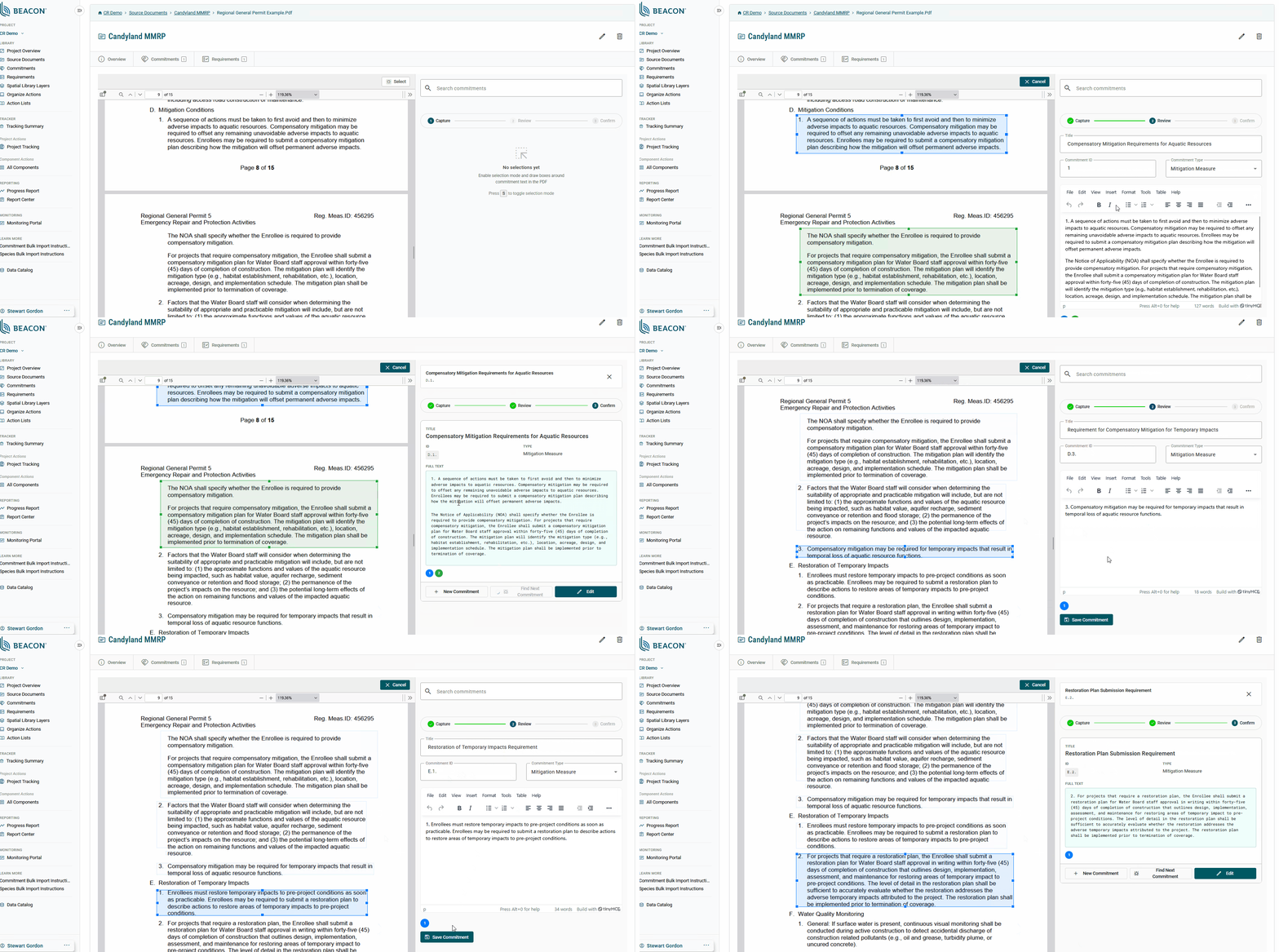
Here again, the emphasis is on transparency and control in a people-centered workflow. Users review and confirm AI-generated suggestions, maintain links back to source documents, and retain confidence that the system reflects real-world requirements. Technology enhances efficiency, but the process remains grounded in professional judgment.
People-Centered Strategy First, AI Second
What ties these efforts together is ESA’s proven Data Diagnostic™ process. Before introducing AI-enabled automation, we focus on understanding the people at the heart of the problem space and how data is actually created, reviewed, shared, and used to support reporting and decision-making.
Through this process, we identify pain points, bottlenecks, and inconsistencies across workflows and systems. This allows us to apply AI use where it can meaningfully streamline processes—such as extracting, validating, or monitoring information—while preserving human judgment where it matters most. By grounding our approach to AI integration in real workflows, we help our clients avoid automating the wrong steps or deploying tools that are difficult to adopt or scale.
AI for the Real World – Work with ESA’s Experts to Realize the Benefits
AI is not a standalone service or a silver bullet. It is one tool within a broader, client-focused practice that integrates data, technology, and domain expertise. When applied with intention, AI can help organizations unlock decades of information, simplify complex processes, and focus limited time and resources on higher-value work.
If you’re facing a data or workflow challenge and aren’t sure where to start, we’d love to help you think it through. Whether the answer involves AI, improved data strategy, or a better way of working, our goal is practical solutions that meet you where you are and move you forward with confidence. Reach out to Mike Leech, Technology Services Practice Leader, and Liz Christeleit, Technology Services Lead, to get started.
Authors

Technology Services Practice Leader

Technology Services Lead
Date
February 19, 2026