

| At a glance: Environmental compliance is most effective when it begins during project planning—not after design decisions are made. Integrating environmental considerations early can help teams identify permitting and mitigation requirements, reduce project risk, avoid costly redesigns, and better prepare for construction and long-term monitoring. |
For many infrastructure projects, environmental compliance is often viewed as a list of tasks to be achieved—a permit secured, a document approved, or a condition satisfied before construction can begin. In reality, the most successful projects treat environmental compliance as an integrated project delivery strategy that begins long before environmental documents are prepared and continues well after construction activities are complete. When compliance considerations are embedded throughout the planning, funding, design, construction, and operations and maintenance phases, projects move more efficiently, experience fewer delays, and are better positioned to achieve both schedule and budget objectives.
The challenge is that many opportunities to integrate compliance are frequently overlooked. By taking a strategic, long-view approach to environmental compliance, ESA helps agencies and project sponsors reduce risk while creating a more predictable path to project delivery.
Environmental Compliance as Design Strategy
ESA considers environmental compliance long before environmental documentation is initiated. During planning studies, master plans, capital improvement planning, and feasibility assessments, project teams have a valuable opportunity to identify potential environmental constraints and opportunities that may affect future implementation.
At this initial stage, understanding resource sensitivities, permit requirements, mitigation obligations, interested parties’ concerns, and regulatory timelines can help shape project alternatives before significant investment is made in a preferred solution. Early environmental screening can identify potential challenges related to wetlands, endangered species, cultural resources, noise, air quality, environmental justice, stormwater management, or construction impacts. Addressing these issues during planning can help avoid costly redesigns later in the process.
Perhaps more importantly, these early assessments can reveal opportunities to build environmental considerations directly into project concepts, creating alternatives that are both operationally effective and environmentally responsible.

Use Environmental Review as a Planning and Design Tool
Environmental review processes required by NEPA, CEQA, SEPA, and similar state and federal programs provide valuable insights that improve project design and long-term operational performance. Environmental analyses frequently identify opportunities to reduce impacts, improve constructability, enhance community acceptance, and strengthen project resilience.
And when environmental specialists are integrated into project design teams during preliminary decisions, potential issues can be addressed before they become constraints. Compliance specialists also draw from decades of experience of managing compliance during construction, to bring lessons learned and proactive solutions.
For example, understanding how construction activities may affect nearby communities can inform staging plans, haul routes, work hours, and site access strategies. Similarly, evaluating biological, cultural, or water resource concerns early can influence design details that reduce permitting complexity and minimize mitigation requirements.
Another effective approach is to integrate environmental strategies and commitments directly into design documents, technical specifications, construction phasing plans, and contract requirements. This ensures that environmental obligations are understood, budgeted for, and achievable.
It’s also important to remember that construction compliance doesn’t end when construction is over. Habitat restoration, wetland mitigation, stormwater monitoring, noise mitigation measures, and other commitments may require years of post-construction monitoring and reporting. Some environmental compliance conditions and permit requirements may extend into the operational phase of the project, resulting in commitments that can extend for 20 or 30 years. Projects that fail to plan for these long-term obligations can face unexpected costs, reporting gaps, and regulatory challenges.
Successful organizations establish compliance management strategies early, ensuring that responsibilities, data collection requirements, and reporting protocols remain in place after construction teams demobilize.
Environmental Considerations During Planning & Design
When ESA’s specialists collaborate with design teams, we consider and find answers to the following key questions:
- How will mitigation measures, permit conditions, and project requirements be implemented in the field?
- What monitoring or reporting will be required during construction?
- Are there seasonal restrictions that affect project implementation?
- How will environmental commitments be communicated to contractors?
- What documentation will be necessary to demonstrate compliance?
Answering these questions during design, and while incorporating solutions into the design plan, can significantly reduce uncertainty during construction and minimize risk.
Modernizing Mitigation Monitoring and Reporting
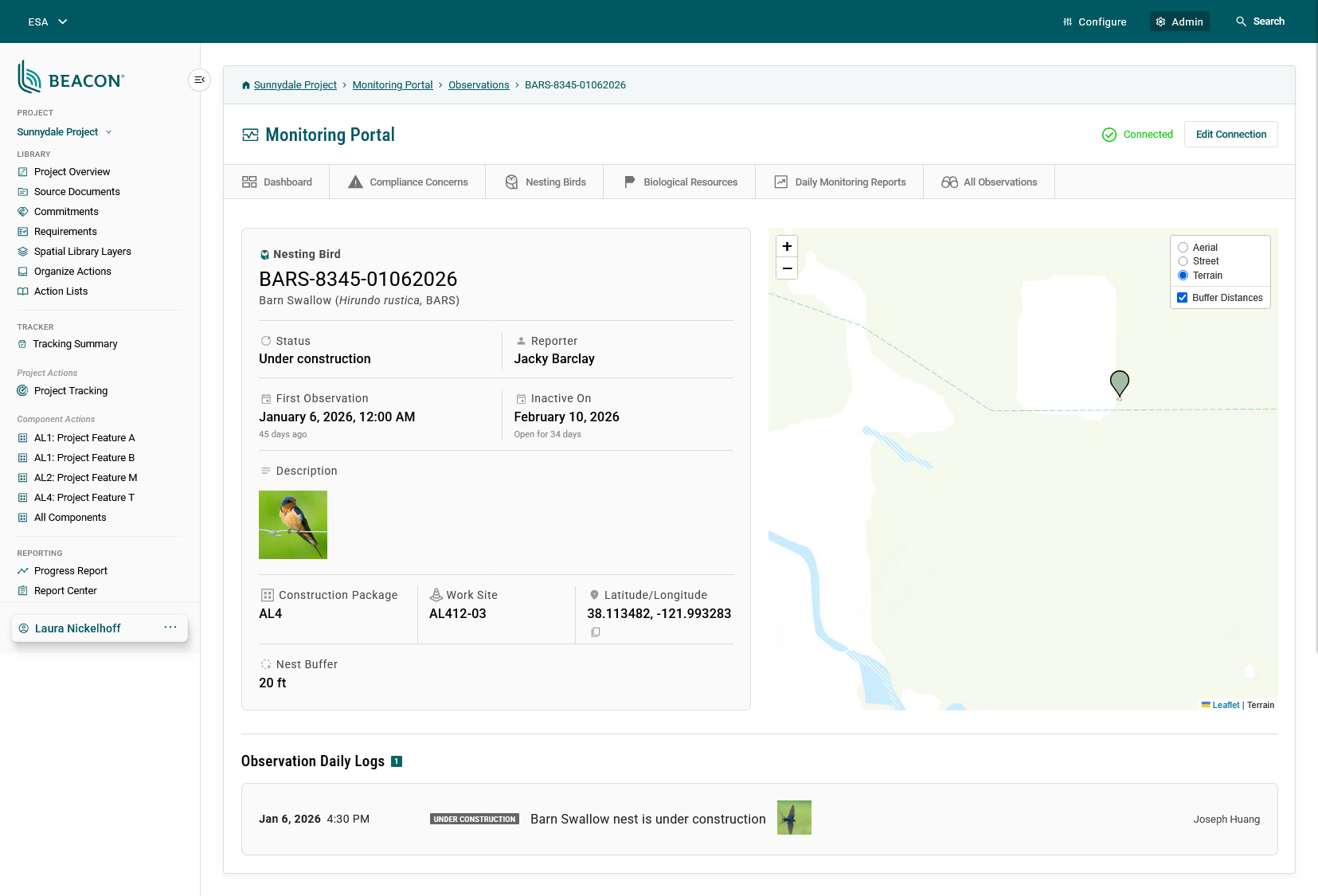
Advances in digital compliance management are changing how organizations track environmental commitments. Cloud-based platforms, mobile field applications, GIS integration, dashboards, and automated reporting tools allow project teams to manage compliance obligations in real time.
For example, ESA’s Beacon® platform transforms mitigation monitoring from a reporting exercise into an integrated project management function, providing real-time visibility into environmental commitments from planning and permitting through construction and long-term stewardship. The tool improves visibility into permit requirements, monitoring activities, corrective actions, and reporting deadlines while creating a comprehensive record of compliance performance.
Digital workflows not only reduce administrative burden but also allow project teams to identify issues sooner and demonstrate compliance more effectively to regulators and funding agencies. In doing so, they help bridge the gap between environmental approvals and successful project implementation, meaning the commitments made on paper are effectively carried through to completion in the field.
A New Perspective on Environmental Compliance
When environmental considerations are integrated throughout the project lifecycle—from planning and funding through environmental review, design, construction, and post-construction monitoring—compliance becomes a strategic advantage rather than a project risk.
In industries where schedules are compressed, budgets are constrained, and regulatory expectations continue to evolve, environmental compliance is no longer simply about obtaining approvals. It is about creating a seamless project delivery framework that supports successful implementation from concept through completion.
For more information about ESA’s environmental compliance capabilities, reach out to Pat Tennant, Director of Environmental Compliance.
Authors

Environmental Compliance Director

Airports / Aviation Market Leader
Date
September 29, 2026