

The U.S. Fish and Wildlife Service (USFWS) has finalized a new regulatory framework for evaluating whether particular areas should be excluded from federal Endangered Species Act (FESA) critical habitat designations. The final rule was published in the Federal Register on July 21, 2026, and becomes effective 30 days after publication.
USFWS and the National Marine Fisheries Service (NMFS) designates critical habitat under FESA by identifying geographic areas that contain the physical or biological features essential to the conservation of listed species, as defined by Section 4(b)(2). Although the rule concerns the designation of critical habitat, it applies only to USFWS. It does not change how USFWS initially identifies areas that meet the statutory definition of critical habitat. Instead, it governs the Section 4(b)(2) of FESA, which authorizes USFWS how to consider economic, national security, and other relevant impacts and determines whether qualifying areas should be excluded from the final designation.
For project proponents, landowners, public agencies, and holders of federal permits or leases, the most important change is procedural. The rule establishes a clearer pathway for submitting information in support of an exclusion, requires USFWS to conduct an exclusion analysis when qualifying information is presented, and directs the agency to exclude an area where the benefits of exclusion outweigh the benefits of inclusion (unless exclusion would result in the species’ extinction).
From Proposed to Final Rule
USFWS proposed the rule on November 21, 2025. The agency finalized the rule substantially as proposed, making only two minor wording changes that do not alter the substantive framework. The first is a minor change from “FWS” to “the Service.” The second replaces “assign” with “give” when describing the weight afforded to certain information, clarifying that the agency is not assigning numerical values to competing considerations. The preamble contains the most significant change from proposed to final rule, explaining how USFWS intends to evaluate exclusion requests, conservation plans, economic information, and the respective roles of the agency and outside experts.
Summary of Changes
The rule creates a more defined process for considering exclusions, but it does not alter the statutory definition of critical habitat, establish that exclusions are favored, or predetermine the result for any project or land use. Each decision remains site-specific and must reflect both the impacts identified in the record and the conservation value of the area under consideration. The following table outlines all changes through the iterations of the rule.
| FESA provision or topic | Previous framework | November 2025 proposed rule | July 2026 final rule |
| Section 4(b)(2) exclusion framework | USFWS relied principally on the joint USFWS–NMFS (the Services) regulations at 50 CFR 424.19 and the Services’ nonbinding 2016 policy. | Proposed a new, binding USFWS-only (does not include NMFS) regulation at 50 CFR 17.90 governing consideration of impacts and exclusions. | Finalized the proposed framework with only two nonsubstantive wording changes. The new rule supersedes the 2016 policy and 50 CFR 424.19 for USFWS exclusion decisions. |
| Information available with proposed critical habitat rules | Draft economic analyses were generally provided, and exclusions were addressed through agency practice and policy. | Required the draft economic analysis to be available for public comment and required proposed rules to identify areas USFWS had reason to consider for exclusion. | Finalized as proposed. Identification of potential exclusions in a proposed rule is neither binding nor exhaustive. |
| Types of impacts considered | Section 4(b)(2) required consideration of economic, national security, and other relevant impacts, with additional guidance provided through the 2016 policy. | Identified a broad, nonexclusive range of impacts, including impacts to jobs, productivity, opportunity costs, Tribes, local governments, public safety, wildfire risk, federal lands, and conservation agreements. | Finalized as proposed. USFWS retains discretion to determine the appropriate geographic and analytical scale and may describe effects qualitatively or quantitatively. |
| Trigger for an exclusion analysis | Whether to undertake the comparative analysis of the benefits of including or excluding an area was generally treated as discretionary by agency, with no criteria specifying when the analysis was required. | Required an exclusion analysis when a proponent presented credible information showing a meaningful economic or other relevant impact supporting exclusion. | Finalized as proposed. USFWS interprets “meaningful” as more than de minimis but declined to define either “meaningful” or “credible information” precisely. |
| Weight given to outside information | The 2016 policy encouraged input from outside parties (i.e., tribes, agencies, landowners, etc.), but did not did not require USFWS by regulation to conduct an exclusion analysis when particular criteria were met. | Directed USFWS to give weight to expert or firsthand information on matters outside the agency’s expertise unless USFWS had information rebutting it. | Finalized with minor wording changes. Relevant sources may include Tribes, state and local governments, national security agencies, and federal permittees, lessees, or contractor applicants. |
| Conservation plans and agreements | The 2016 policy described how permitted and nonpermitted conservation plans could support exclusion. | Codified factors for evaluating Section 10 plans and voluntary or nonpermitted conservation plans, agreements, and partnerships. | Finalized as proposed. Such plans do not guarantee exclusion, but their implementation, effectiveness, monitoring, adaptive management, and conservation value may support it. |
| Outcome when exclusion benefits outweigh inclusion benefits | Under the 2016 policy, USFWS characterized the ultimate decision to exclude as discretionary. | Provided that USFWS “shall exclude” an area when exclusion benefits outweigh inclusion benefits, unless exclusion would result in extinction. | Finalized as proposed. Once USFWS performs the analysis and reaches that conclusion, exclusion is mandatory under the regulation. |
A flowchart of how the new exclusion process will work, illustrating the steps USFWS will take, is provided below.
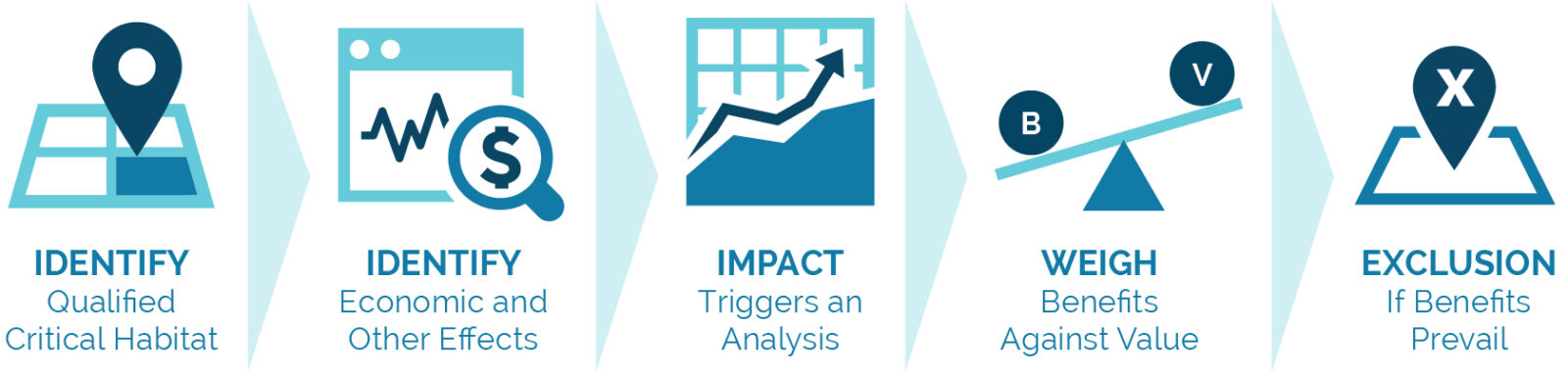
1. USFWS first identifies areas that qualify as critical habitat
USFWS must identify critical habitat using the best scientific data available. Only after an area qualifies biologically does Section 4(b)(2) allow consideration of whether it should be excluded.
2. Economic and other effects are identified during the proposed designation
When proposing critical habitat, USFWS must make its draft economic analysis available and identifies areas it has reason to consider for exclusion. Relevant considerations include economic effects, opportunity costs, national security, Tribal and local government interests, public safety, conservation agreements, federal land uses, and ecosystem services.
3. Credible information showing a meaningful impact triggers an analysis
USFWS must conduct an exclusion analysis when presented with credible information demonstrating a meaningful economic or other relevant impact supporting exclusion. The agency intentionally declined to adopt rigid definitions, instead evaluating submissions on a case-by-case basis.
4. USFWS weighs exclusion benefits against conservation value
The agency compares the benefits of inclusion and exclusion while retaining responsibility for biological judgments. For issues outside its expertise, it gives weight to expert or firsthand information unless rebutted by other evidence. The rule rejects assigning numerical weights to competing considerations.
5. If exclusion benefits prevail, USFWS must exclude the area
The regulation’s use of ‘shall exclude’ is one of its most significant changes. If USFWS concludes that exclusion benefits outweigh inclusion benefits, it must exclude the area unless doing so would result in extinction of the species.
USFWS maintains that the rule does not eliminate the Secretary’s statutory discretion. Rather, the Secretary is exercising that discretion in advance by establishing how the agency will act once the balancing test has been completed.
Key Takeaway
The final rule formalizes how the agency will consider requests to exclude specific areas after determining that those areas otherwise meet the definition of critical habitat. Whether an area is excluded will depend on the record developed for that designation, the relative benefits of inclusion and exclusion, and the statutory limitation that an exclusion may not result in extinction of the species.
The following issues may be relevant to understanding how the rule could affect project planning and later permitting:
Which projects and land uses may be associated with an exclusion request?
The final rule does not identify categories of projects that should receive exclusions. Instead, it allows USFWS to evaluate whether a particular area should be excluded from critical habitat when a proposed designation could result in meaningful economic, national security, land-management, or other relevant impacts. The following examples illustrate how the rule could apply in practice.

A developer proposes a utility-scale solar project on Bureau of Land Management (BLM) land. During project planning, USFWS proposes critical habitat that overlaps part of the project site.
Rather than waiting for Section 7 consultation, the developer submits information during the proposed critical habitat rulemaking describing:
- Expected project redesign costs
- Potential construction delays
- Existing habitat management commitments
- The limited incremental conservation benefit of designation
If the information demonstrates a meaningful economic or other relevant impact, USFWS would be required to conduct a Section 4(b)(2) exclusion analysis for the affected area.
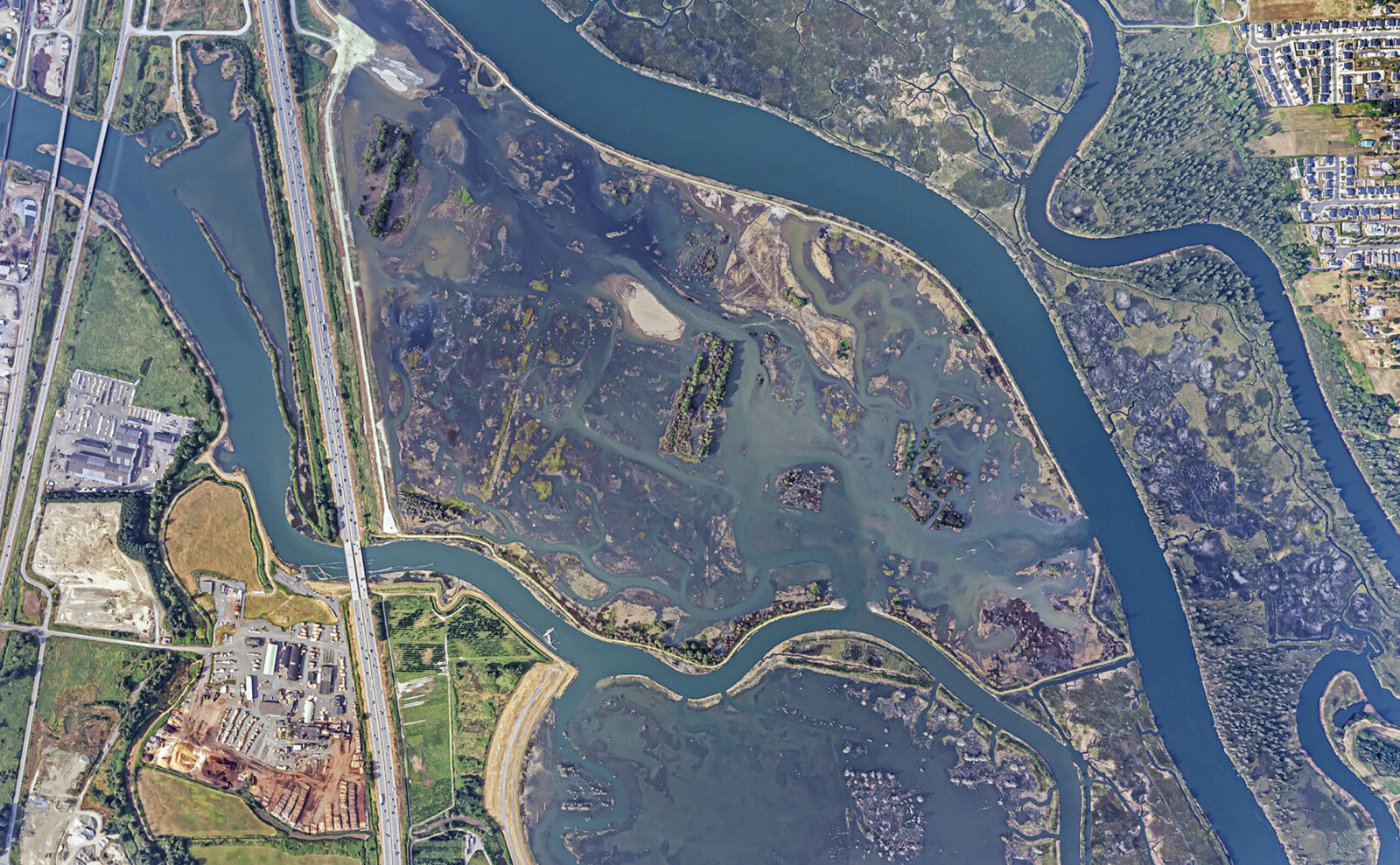
A flood control district plans improvements to an existing levee and channel system requiring authorization from the U.S. Army Corps of Engineers. During project development, USFWS proposes critical habitat that includes portions of the project corridor.
During the public comment period, the district submits information describing:
- Potential construction and maintenance delays
- Increased long-term maintenance costs
- Existing habitat restoration commitments
- Adaptive management measures implemented through a regional conservation program
If the submitted information demonstrates a meaningful economic or other relevant impact, USFWS would be required to evaluate whether excluding that portion of the proposed critical habitat is warranted through the Section 4(b)(2) analysis.
What information may be relevant, and when is it considered?
USFWS must conduct an exclusion analysis when credible information identifies a meaningful impact that supports consideration of exclusion. The final rule does not establish a fixed evidentiary threshold, and generalized or speculative effects may be insufficient. Relevant information may include maps and project plans, anticipated federal authorizations, economic or engineering analyses, schedule or operational effects, land-management commitments, and information from agencies, permittees, lessees, Tribes, local governments, or other subject-matter experts.
This information is considered as part of the critical habitat rulemaking, typically during the public-comment period on the proposed designation. The exclusion decision therefore occurs before, and separately from, any later project-specific Section 7 consultation.
How could exclusion affect a later Section 7 consultation?
If an area is excluded from critical habitat, a later federal action affecting that area generally would not be analyzed under Section 7 for destruction or adverse modification of critical habitat. This could narrow the habitat-related portion of a consultation in some cases.
Exclusion does not remove other FESA requirements. Federal agencies must still evaluate whether an action is likely to jeopardize a listed species, and incidental take authorization or other federal and state approvals may still be required. The practical effect will therefore depend on whether designated habitat or direct effects on listed species would otherwise be the principal issue in consultation.
How are existing conservation plans considered?
The rule identifies HCPs and other conservation plans or agreements as relevant to the exclusion analysis. USFWS may consider whether a plan is being implemented, whether it addresses the species and habitat at issue, the effectiveness of its conservation measures, and the durability of monitoring, adaptive management, funding, and oversight commitments.
An existing plan does not create a presumption of exclusion. Instead, it is one part of the record USFWS may use to assess the conservation benefits of including or excluding a particular area. The significance of a plan will depend on its terms, implementation, and demonstrated conservation value.
Our Advice to Clients
Although the final rule establishes a more defined regulatory framework for evaluating critical habitat exclusions, it does not change how critical habitat is identified under the Endangered Species Act or eliminate the need for project-specific permitting analyses. Exclusion requests remain highly fact-specific and depend on the quality of the information available during development of a proposed critical habitat designation. As projects move through planning and permitting, we recommend that project teams:
- Continue conducting early biological constraints analyses during site selection and project due diligence.
- Monitor proposed critical habitat designations affecting project areas, particularly where future federal permits, approvals, or funding may be required.
- Evaluate whether existing conservation measures, Habitat Conservation Plans (HCPs), or other resource management programs may be relevant to any future exclusion analysis.
- Develop permitting strategies that consider both listed species and designated critical habitat, recognizing that each is evaluated under separate standards during Section 7 consultation.
- Coordinate early with federal and state resource agencies when projects may intersect with proposed critical habitat designations or other evolving FESA requirements.
Importantly, the final rule should not be interpreted as reducing protections for critical habitat generally. Rather, it establishes a more transparent process for how USFWS will evaluate requests to exclude areas based on the facts presented during a critical habitat rulemaking.
Looking Ahead
While this rule is now final, it represents only one component of a broader series of ongoing revisions to FESA implementation. Importantly, this final rule applies only to USFWS. The National Marine Fisheries Service (NMFS) did not participate in this rulemaking and continues to implement critical habitat exclusions under the existing joint regulations. As a result, project proponents should recognize that exclusion requests involving NOAA Fisheries’ jurisdiction—including most listed marine species, anadromous fish, and their designated critical habitat—will continue to follow the current regulatory framework unless and until NMFS adopts similar changes. Three additional rulemakings remain pending and, if finalized, could further reshape how the Services administer the Act. As discussed in our previous article, Eroding the Federal Endangered Species Act: New Proposals Lessen Species and Habitat Safeguards, the Services are still considering proposed regulations that would:
- revise the regulations governing interagency cooperation under Section 7, including consultation procedures and the definition of the environmental baseline;
- modify the regulations implementing the designation and management of critical habitat; and
- revise the regulations governing endangered and threatened species listings, including the treatment of foreseeable threats and other listing considerations.
In addition, the Services continue to develop updates to the Section 7 Consultation Handbook, which will provide important implementation guidance for regulatory changes once finalized. Taken together, these actions suggest that FESA implementation will continue to evolve. Rather than viewing any single rulemaking in isolation, project proponents should expect agencies to implement these changes as part of a broader shift in FESA policy, with future litigation and additional agency guidance likely to shape how the new regulations are applied in practice.
We are here to help. ESA will continue monitoring implementation of the USFWS final rule, the remaining pending FESA rulemakings, related litigation, and any future actions by NMFS that could affect critical habitat exclusions or other aspects of FESA implementation. We will continue advising clients on project-specific permitting strategies that are responsive to this evolving regulatory landscape. If you have questions about how these changes may affect your projects, please contact Barbra Calantas, Biological Resources and Land Management Practice Leader.
Author

Biological Resources and Land Management Practice Leader
Date
July 29, 2026