


Artificial Intelligence (AI) continues to advance in its capabilities and gain broader adoption across both public and private sectors. Although deploying AI across various workflows can create noticeable efficiencies, it can also introduce risk in the process. Successfully optimizing those efficiencies, while managing and mitigating the associated risk, is central to effective AI adoption, particularly for public agencies. New and emerging innovations in environmental review and permitting offer useful test cases in how agencies can responsibly integrate AI into their workflows.
ESA’s AI & Emerging Technology services helps agencies turn their interest in AI into actionable roadmaps, by combining our technology expertise with National Environmental Policy Act (NEPA) and environmental subject-matter knowledge. Based on our agency outreach, market analysis, and experience applying AI within environmental planning and review, we have identified several considerations agencies should address before buying, building, or scaling AI tools.
Have a Clear AI Vision with Executive Team Sponsorship
To support the meaningful integration of AI in environmental planning, agencies need a shared vision and a coordinated implementation strategy backed by executive-level sponsorship. This high-level vision means that AI implementation strategies should focus on solving real problems, not hypothetical ones. Successful AI development also requires close collaboration between technology teams and subject matter experts (SMEs), whose technical expertise, industry knowledge, and understanding of prospective users’ needs are essential for developing effective and practical solutions.
Write an AI Policy
A good AI policy provides a framework for pilot projects and initiatives and establishes guardrails to protect the agency. Ideally, agencies should establish baseline AI guidance before launching pilots, with policies designed to adapt as models, tools, risks, and use cases evolve and mature. Agencies should define who can approve AI initiatives, who owns the deployed systems, who accepts any associated risk, what requires legal/security/privacy review, and when oversight and review are required.
This becomes increasingly important as agencies move beyond using chatbots that simply answer questions, to AI agents that can complete tasks or take actions on a user’s behalf, such as reviewing documents, updating records, routing information, or initiating parts of a workflow. Policies should clearly define when human review and approval are required and ensure that final decisions remain accountable to agency staff.
List and Prioritize Potential Use Cases
Agencies need a consistent approach to identify and rank opportunities based on their value, feasibility, risk, data readiness, and measurable outcomes. Otherwise, AI programs tend to become collections of interesting pilots rather than a portfolio of deliberate investments toward objectives. Before implementing AI-enhanced programs or applications, agencies should also establish baseline measures, such as hours spent, processing time, cost, error rates, backlog, quality, user experience, etc., so they can demonstrate if AI improved the process (or not).
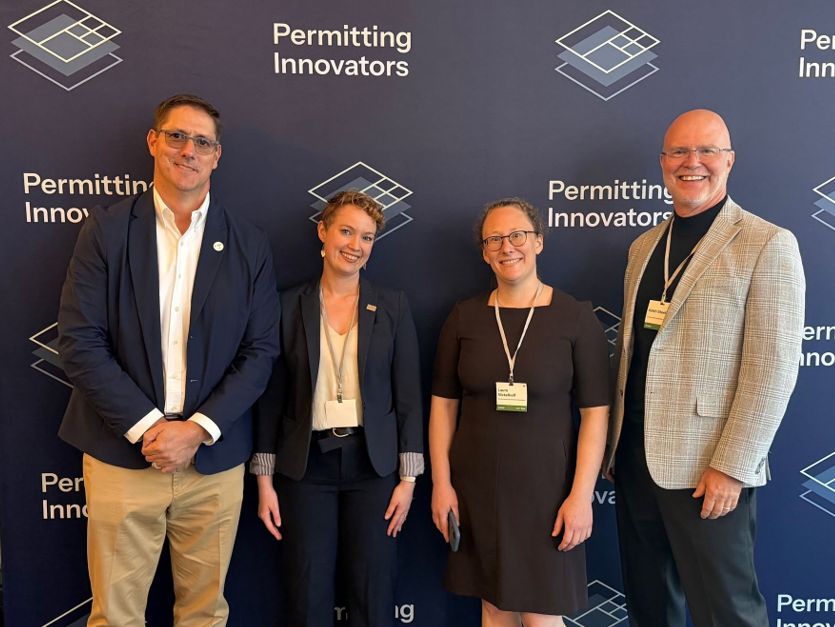
ESA is actively helping agencies explore practical, responsible applications of AI in environmental planning. Since the beginning of 2026, ESA has:
- Led two agency-focused AI workshops.
- Released two free AI tools: the CE Virtual Assistant and NEPA Assignment Navigator.
- Delivered conference presentations on technology and AI in environmental planning.
- Provided AI training for NEPA project managers.
- Led two national webinars.
- Facilitated more than seven working group meetings focused on AI.
- Earned a Top 10 spot in the White House Council on Environmental Quality’s technology showcase.
Together, this work is giving ESA a firsthand view of how agencies are evaluating, adopting, and applying AI—and what they should consider before building or buying a tool of their own.
Agencies that address these issues before investing in individual tools will be better positioned to move beyond isolated pilots and use AI in ways that provide measurable, sustainable value.
Test for Validation and Quality Assurance
Agencies also need parameters to determine when an AI product is ready for implementation. For environmental planning, these criteria could include accuracy benchmarks, citation and source verification, hallucination testing, comparison against SME work products, and bias testing. Once deployed, AI systems should be monitored and consistently evaluated, as models, underlying data, regulations, and workflows evolve.
Create a Change Management Plan
Practical applications of AI can be beneficial, but they require providing staff with the skills to use the resources that are developed. Without adequate training, at best, AI applications would be unlikely to be adopted, and at worst, could be dangerous to the organization. For example, staff could unintentionally enter sensitive cultural resources information into an AI tool that retains or uses that data for future model training, creating privacy, legal, and data-governance risks.
Even with a shared vision, strong policy, and well-trained staff, AI adoption can still fall short without a clear change management plan. A strong change management plan encourages AI adoption and fosters a culture of responsible AI use. Activities such as mini-hackathons (or “prompt-a-thons”), in which participants collaborate and experiment with prompts and generative AI tools, are an excellent way to energize staff, promote knowledge exchange, and increase organizational readiness for AI adoption.
Evaluate Your Data
AI is only as useful as the data behind it. Before implementing AI solutions, agencies must review and evaluate their existing data, and should ask the following questions: Is the data all in one central location? Are the documents formatted in an “AI-friendly” way? Is the data high-quality? Is there information in the data that is no longer relevant or so dated that it is no longer useful, i.e., outdated regulations or survey methodologies? In many cases, agencies may need to improve data governance, document organization, metadata, and records management before AI tools can produce reliable and scalable results.
Back It Up with Infrastructure
Before agencies buy or build AI tools, they need to understand whether their existing infrastructure can support responsible implementation, including approved platforms, cloud-based services, cybersecurity requirements, data privacy protections, acquisition, records retention, and integration with existing systems.
A small internal pilot may have limited infrastructure needs, but scaling AI across an agency requires clear ownership, user permissions, maintenance plans, control, auditability, and a process for updating tools as regulations, templates, and guidance change. Bringing IT, security, legal, acquisition, records, and environmental staff into the conversation early helps agencies identify what is possible now, what needs strengthening, and what type of AI investment makes sense.
Developing AI-Powered Solutions, Together
AI adoption within environmental planning works best when agencies start with the fundamentals: a clear vision, executive sponsorship, practical policies and governance, staff training, change management, usable data, and infrastructure that can support responsible implementation.
For more information about how ESA can help develop AI-powered technology solutions for common challenges in environmental data management and regulatory processes, visit our AI & Emerging Technologies page, or reach out to Senior Transportation Planner Lauren Schramm and Technology Director Keith Steele.


Date
September 9, 2026