

| What you should know: The Surface Transportation Project Delivery Program, known as NEPA Assignment, accelerates surface transportation projects by designating key federal environmental review responsibilities to qualifying states. To help transportation agencies navigate this application process easier, ESA has created an AI-supported NEPA Assignment Navigator GPT to help them understand the program’s requirements and processes. |
The Surface Transportation Project Delivery Program, known as NEPA Assignment, has proven highly effective at accelerating project delivery by allowing qualified states to assume key federal environmental review responsibilities. States participating in NEPA Assignment report not only faster review times and reduced costs, but also improved agency coordination and public engagement, making the program a model for streamlining transportation project approvals. With this in mind, USDOT Secretary Sean Duffy sent a letter to governors, encouraging them to pursue NEPA Assignment.
What Is NEPA Assignment?
NEPA Assignment permits state Departments of Transportation (DOTs) and other statewide transportation agencies (e.g. California High-Speed Rail Authority) to take on the USDOT responsibilities under the National Environmental Policy Act (NEPA) and other federal environmental laws for highway and other surface transportation projects. By doing this, states gain direct control and accountability for environmental reviews under NEPA.
How Do You Apply?
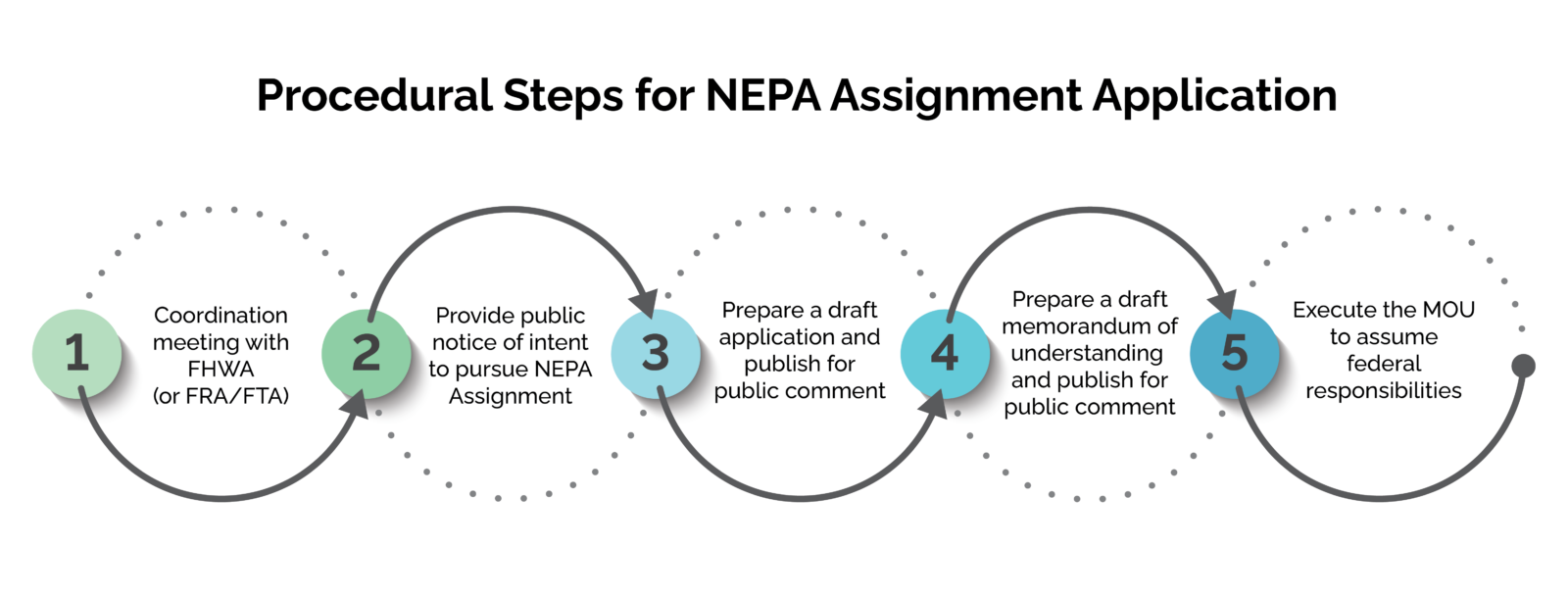
Taking on NEPA Assignment is no small feat and can take more than a year to complete the application process. To be determined eligible, interested states need to follow a series of well-defined steps to prove that they have the capacity, expertise, and organizational and administrative structures in place to effectively “stand in the shoes” of the federal government. Those steps are detailed in the statutory language (23 U.S.C. 326 and 23 U.S.C. 327) and the implementing regulations (23 CFR Part 773).
Procedural Steps for NEPA Assignment Application
How NEPA Assignment Accelerates Project Delivery
- Substantial Time Savings: States with NEPA Assignment consistently achieve faster processing of Categorical Exclusions (CEs), Environmental Assessments (EAs), and Environmental Impact Statements (EISs). For example, California’s annual performance report showed median time savings of more than 11 months for environmental assessments and up to 122 months for final EIS approvals.
- Cost Efficiency: By minimizing duplicate reviews and streamlining documentation, states like Ohio report saving over $32 million in construction delays/inflation costs between 2015 and 2019.
- Improved Coordination: Assigning NEPA responsibility to states enables better local stakeholder engagement, faster interagency consultation, and more tailored decision-making, which collectively avoid bottlenecks typical in federal reviews.
- Accountability and Innovation: Out of necessity, states often develop new digital systems, public engagement platforms, and quality control protocols to meet their federal obligations, raising both accountability and quality of outcomes. With NEPA Assignment, Caltrans met or exceeded its compliance goals for virtually all federal requirements in 2024, with only minor, correctable procedural issues found in annual monitoring.
How ESA Can Help
To make the application process easier, ESA has created an AI-supported NEPA Assignment Navigator GPT that will help states considering NEPA Assignment understand better what’s required, how other states have satisfied the requirements, and generally provide conversational support for your NEPA Assignment questions.
Users of the tool can ask questions, like:
- What are the requirements for a NEPA Assignment application?
- What are the differences between “CE” and “Program” assignment?
The GPT will review current and helpful resources and provide a validated response with citations. If you have questions about NEPA Assignment and would like to learn more about how ESA can support your exploration of NEPA Assignment, please reach out to Eric Beightel, Federal Strategy Director or Lauren Schramm, Senior NEPA Planner. Before joining ESA, Eric served as consultant lead for California in obtaining NEPA Assignment from FRA and was also a former senior environmental policy advisor to the U.S. Secretary of Transportation coordinating closely with FHWA on the NEPA Assignment program. Lauren recently joined ESA, bringing a specialty in NEPA consultation for transportation projects and a passion for technology in the environmental space. She won a USDOT Innovation Challenge for a custom GPT to support knowledge sharing at DOTs and is helping to lead ESA’s work in this area.


Date
January 26, 2026